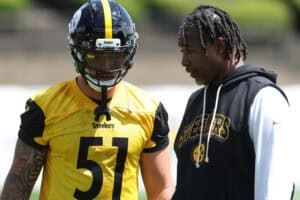
In one week, Patrick Graham radicalized Pittsburgh’s defensive philosophy
The Steelers knocked off the Atlanta Falcons 20-13 in Week One, authoring a strong defensive performance that held Atlanta to 238 total yards and a single touchdown.
Granted, with third-string quarterback Cooper Rush in the lineup, shutting down the Falcons’ offense wasn’t shocking. But the way in which new defensive coordinator Patrick Graham bottled up Atlanta, and what it says about him, was a big departure from how defense has operated in Pittsburgh for years.
Graham came to the Steelers with a reputation as an aggressive play-caller. With the exception of 2025, when he coordinated Pete Carroll’s defense in Las Vegas, Graham was annually among the league leaders in blitz rate. Graham twice led the league in seven-man blitzes, aka bringing the house. Few coordinators love blitzing more than Graham. Few cities love the blitz more than Pittsburgh. Perfect synergy.
Graham also likes to play man coverage behind those blitzes. The Raiders were above average in cover-1 rate each of Graham’s four seasons as coordinator. They weren’t blessed with the talent in the secondary Pittsburgh has, yet Graham was undeterred. The expectation was he would lean even more into cover-1 with his stable of corners here.
Then, on Sunday, in his first game as coordinator, he blitzed less than anyone in the NFL. Graham brought five rushers or more on just 10.5% of Atlanta’s offensive snaps. The league average for the week was 30%. I had Graham pegged at around 40.
Every NFL defensive play caller ranked by blitz rate in Week 1:
Brian Flores: 82.1%
Dan Quinn: 50.9%
Aaron Glenn: 44.9%
Jesse Minter: 43.4%
Kelvin Sheppard: 43.0%
Todd Bowles: 42.9%
Lou Anarumo: 39.1%
Mike Macdonald: 35.8%
Vic Fangio: 35.8%
Christian Parker: 35.3%
Zak Kuhr:…— Ryan Paganetti (@RyanPaganetti) September 14, 2026
Graham also dramatically changed his coverage philosophy. He played zone exclusively — on all 57 of Atlanta’s offensive snaps. The Steelers were the only team in the league in Week 1 to play nothing but zone.
And the results? Excellent. Despite barely blitzing, they recorded four sacks and had a respectable pressure rate of 28%. By pressuring Rush with just four, they were able to drop seven in coverage, keep the Falcons in front of them and rally to the football when Rush checked it down.
Dropping seven was particularly important in containing Bijan Robinson, Atlanta’s biggest threat. Robinson racked up some pretty good numbers — 173 combined rushing and receiving yards — but other than a 23-yard catch-and-run that, incidentally, came against the blitz, Robinson’s damage was kept to a minimum. Rush targeted Robinson on a variety of underneath routes — swing passes, perimeter screens, hitch routes — and when he did, the Steelers sprinted from their zones to gang tackle him. Sure, Robinson got his catches against zone, and he made some yards after the catch. But the goal was to limit explosives. Playing zone helped the Steelers do that.
Bijan Robinson put up good numbers on Sunday (173 total yds) but PIT did a nice job of limiting the damage by rallying to him and gang-tackling.
Good example here. Six defenders converge on Robinson on this swing screen. Great lane discipline gets ATL off the field on 3rd/long. pic.twitter.com/yJHOvpxWka
— Kevin Smith (@KTSmithFootball) September 15, 2026
Zone was also a good call because of the absence of Joey Porter Jr. With Porter and Jamel Dean in the lineup, the Steelers have one of the best man-coverage duos in the league. Without Porter, not so much. Asante Samuel has played good football so far, but at 5’10-180 pounds, he would have struggled against the likes of Drake London and Kyle Pitts.
Graham may like cover-1, but it wasn’t right for this personnel matchup. So he didn’t play it.
Additionally, zone coverage forced Rush to hold the ball in the pocket, diagnose coverage and find seams in the defense. That’s a tougher ask of him than picking a matchup and throwing that player the ball against man-to-man. That strategy would have given Robinson, London and Pitts an opportunity to make plays against isolated defenders. The former put the onus on Rush to beat coverage. Graham wisely picked Rush.
In just one week, Graham showed how flexible he can be, and how well he can scheme for a particular opponent. He didn’t have much time to game-plan for Rush, considering it wasn’t announced until Thursday that Rush would start in place of an injured Tua Tagovailoa. Graham also had uncertainty about Porter’s situation to consider. And yet he dialed up a smart strategy that bucked some of his personal trends to put the clamps on the Falcons.
If you want to pause here and say, Coach, don’t get carried away, it was Cooper Rush, I’ll understand. But there’s a bigger picture to consider. Philosophically, what Graham did on Sunday is a huge departure from the Mike Tomlin era. Tomlin was famous for “doing what we do.” He believed in his system, and he believed if it was taught and executed properly, it contained the answers for just about any offense. While Tomlin’s defenses were far more effective than not, opponents proved many times they could also be predictable and antiquated.
Some felt so comfortable against the scheme they told reporters about it after the game. “We knew what they were going to do” became a mantra for frustrated Steelers fans. In just one game, Graham put that mantra to bed.
How will he scheme for Drake Maye and the Patriots this coming Sunday? Maybe he’ll run back his coverage script from Week 1. It worked for Seattle, who played zone on 94% of its snaps against Maye last week in bottling up New England. McDonald also blitzed Maye at a high rate (36%). Maybe Graham will, too.
Or maybe he won’t. We don’t really know. Graham will look at the film, evaluate his personnel, decide what his group can do best to stop New England, and build from there. Ironically, he learned that strategy while working for Bill Belichick and the Patriots. Now he gets to apply it against them.
That sounds like a perfectly radical idea to me.
For more of my content, follow me on X @KTSmith football, and tune in to the “Here We Go” Steelers show with me and Bryan Anthony Davis as well as my “Steelers Chalk Talk” show every Thursday on Steel Curtain Network.



You would like to limit Robinson to better than 6 yards per touch, but he was mostly contained and I don’t think they were worried about anyone else beating them.
I agree in theory. But if we look at it more globally, the only way ATL could win was if Robinson went off. He averaged 6.3 yards per touch last season, so holding him to his average was pretty good when you consider ATL was going to do everything they could to get him the ball and try to create explosive plays with him.
A couple of things:
1) That list. Ughh. Mixing up DC’s and HC’s is pretty rough. I *assume* that they used HC’s when they were a defensive minded coach, but who knows. Just put down the DC. Geez
2) Last week was my first time really seeing Bijan. WOW is he a good player. Credit where it’s due, but he is the Atlanta O. Pitts/London who?
3) LOOOOOOVE that we are being less predictable. Lets go win some games!
I think we’ll see a higher blitz rate this week. I’m sure the fact we were playing Cooper Rush factored in. No point using a bazooka when your .22 can do the job.
I definitely like the idea that Graham will adjust based on his opponent and on the players he has available to him in a given week.
You can see from the chart in the article that Mike McDonald blitzed Maye at a 35.8% clip. That was one of the higher rates in the league last week. Stands to reason without AJ Brown the Steelers will be more willing to heat Maye up. Just have to account for Hunter Henry when they do. That guy kills the Steelers (19 catches and 6 TDs in 4 career games vs PIT).
This is such an exceptional breakdown Kevin! Thanks for this! I know it’s just week 1, and I know the team showed the rust of it being week 1, and I know it felt “same-ish” in the moment — but it’s equally good to know that under the surface of what we could “see” plainly, was the underpinning of “different”! Thank you!
Thanks! Same is true for the offense. Looked like last year in real time but wasn’t last year at all. If a few plays had gone differently, we’d be raving about the “new look” offense.
I wholeheartedly agree!
I’m so happy to put the TA/MT “we do what we do” philosophy in the past, and I very much look forward to the evolution of the 26 Steelers D.
As much as I liked Tomlin he had some of the worst coordinators in last few seasons of his tenure.
It would be good to understand how many Robinson plays were stopped for one or 2 yards or no yards, or even TFL?
Top-notch breakdown, Kevin! As always…
Ask and ye shall receive.
Bijan Robinson touches vs Steelers:
2 yards or less: 10
3-6 yards: 9
7 yards or more: 10
One thing I liked about this game was I never had this thought at any point: “They’re gonna screw around and lose this game.”
They went into a game that they were expected to win and won it. Now, would it have been nice if the running game looked better and some great throws by Rodgers weren’t wasted on drops and PI non-calls? Absolutely, but I didn’t have to turn off the game to save my blood pressure from going through the roof.
I just hope to see the Steelers change their philosophy to best defeat their opponent going forward. I approve of what they did, but one point does not make a trend line.
Time will tell, but so far I like the idea of not knowing exactly what the Steelers’ defense is going to do and who exactly is going to do it.