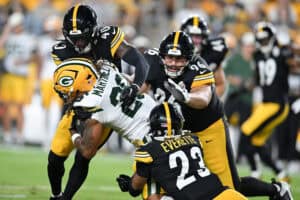
Steelers Playbook: Patrick Graham shows a glimpse of his creativity versus Green Bay
The Steelers didn’t show much of their playbook on either side of the football in last Thursday’s 28-9 pre-season win over Green Bay. It’s exhibition season, after all, where the schemes are largely vanilla and the emphasis is typically on execution and fundamentals.
Still, new coordinator Patrick Graham did show some interesting looks that may have provided a window into the defense when the regular season arrives. Here’s a breakdown of some of his most interesting designs against the Packers.
SIMs
I’ve written a lot about Graham’s use of “SIMs,” or simulated blitzes, in previous articles, as well as on my “Steelers’ Chalk Talk” podcast. A SIM is a defensive scheme where the appearance of a blitz is presented at the line of scrimmage prior to the snap, usually by aligning six or even seven players on the ball. Then, at the snap, several of these players will bail into coverage while just three or four rush the passer. It’s not a blitz, but by making the offense prepare for one, the defense can often cause confusion in the quarterback’s reads or in pass protection. They may also force the offense to check into something for which the defense is prepared.
That last point came to fruition on a 3rd-and-10 snap in the first quarter on Thursday. The Packers aligned in an empty formation, and Graham responded with a five-man coverage shell and six potential rushers. Quarterback Tyrod Taylor knew the Packers could only block five, and that if six came the free rusher would be on him too quickly to allow anything to develop down the field. So Taylor checked into a perimeter screen where he could get the ball out immediately.
The Steelers, however, did not send six. They rushed four, with linebackers Payton Wilson and Patrick Queen falling back into coverage. Wilson ran free to the football and made the tackle short of the sticks:
We’ve talked a lot about Patrick Graham’s “SIMs,” or simulated pressures, where he shows a blitz-heavy look but peels off and rushes four.
Here’s your first SIM from Graham. It tricks Tyrod Taylor into a quick screen check, and the Steelers run it down to force a punt. pic.twitter.com/RYZINqgsIn
— Kevin Smith (@KTSmithFootball) August 13, 2026
In this instance, Graham’s SIM prompted a Packers’ “hot” check for which the Steelers were prepared, allowing the defense to force a punt.
We saw another SIM from Graham in the second quarter. This one came on a 3rd-and-4 play. This time Pittsburgh put seven players at the line and showed a four-man coverage shell. Green Bay was in a balanced two-by-two set with the back to the left of quarterback Kyle McCord. At the snap, four defenders dropped and three of the original seven at the line rushed McCord. The fourth rusher came from the second level, which was a nice wrinkle on the traditional SIM. With so much to process, McCord double-clutched and held the ball in the pocket as he attempted to decipher coverage. Unfortunately for the Steelers, they also ran a twist stunt with the right edge knifing inside and the nose tackle looping around to act as contain. The loop got picked up, exposing the edge, and McCord escaped the pocket to run for a first down. While the execution wasn’t quite there, the intent of the stunt — to confuse McCord and force him to hold the ball — was true.
Another SIM from Graham. QB escapes the pocket and scrambles for a 1st down, but you can see how these disguises make him hold the ball in the pocket. Eager to see what these look like with the Steelers’ varsity on the field. pic.twitter.com/YJ2CtbXNw6
— Kevin Smith (@KTSmithFootball) August 14, 2026
CHANNELING DICK LeBEAU
In the second half, Graham ran a fire-zone blitz that made me chuckle. As I watched it again and again on the All-22, I couldn’t help but think how proud former Steelers’ DC Dick LeBeau, the father of the modern fire zone, would be. Graham may have been overly-ambitious with this particular design, considering he was working exclusively with backup personnel, but it was a scheme LeBeau eagerly would have run with Troy Polamalu in the early 2000s.
For reference, a fire zone is a blitz with zone coverage behind it. LeBeau introduced these to the football world first in Cincinnati in the 1980s and then with the Steelers in the Blitzburgh era. A decade later, he ran them to perfection with Polamalu as his jack-of-all-trades. Graham didn’t have anyone resembling Polamalu on the field when he dialed up this fire zone Thursday night. Instead, he had Sebastian Castro, a fringe roster player, manning the Polamalu role. It was an A for effort on Castro’s part, however, and an A+ for creativity from Graham.
On the play, Castro (49), a safety, aligned on the right edge of the defense as though he were going to rush the quarterback. At the snap, Castro peeled off and sprinted back towards the deep middle of the field while the actual blitz came from the opposite edge. The Steelers rotated into a cover-3 look with three underneath defenders and three deep. Castro doesn’t have ideal speed to get the depth required to protect the post in this scheme, but Green Bay opted to throw a hitch route to the weak side of their trips formation and never threatened his zone:
(1/2) Patrick Graham is known for his creative post-snap coverage rotations, but he went full Dick LeBeau on this play Thursday night.
Watch safety Sebastian Castro (49) line up on the right edge before sprinting to the deep middle at the snap. That’s some Troy Polamalu stuff. pic.twitter.com/tbHhdFcpWd
— Kevin Smith (@KTSmithFootball) August 15, 2026
I don’t know if Graham was just tinkering with this particular fire zone or if he intends to run something similar in the regular season. It’s a wicked stunt in terms of its disguise, but a tough one to execute if an offense can sniff it out and send a receiver to the deep middle. Still, it shows that Graham is willing to be both bold and creative.
Whether they are SIMs, seven-man blitzes, intricate coverage rotations or Dick LeBeau-inspired wizardry, we’re absolutely going to see some schemes from the defense this season we haven’t seen in years.


