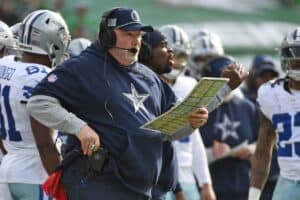
The Steelers should have their most professional passing attack in years under Mike McCarthy
If you read that headline and and were immediately skeptical, I understand. Any discussion of the Steelers’ passing attack next season should begin with an obvious question: who’s the quarterback? You can’t speculate on the success of the passing game, or even on its structure, until you know who will actually be passing the football.
Or can you?
This isn’t to suggest the quarterback won’t matter. Of course he will. We saw the difference this past season, where Aaron Rodgers brought a higher level of competence to the position, and better results overall, than any of his recent predecessors. Maybe Rodgers will be back in 2026 (I think he will). Maybe someone else will run the show. But the offense that quarterback will orchestrate, and in particular its passing game, will look a lot different than anything the Steelers have run in recent seasons. Based on what I’ve studied of Mike McCarthy’s career, this will be a good thing.
McCarthy’s West Coast passing attack is professional and comprehensive. I’ve discussed West Coast principles on multiple platforms, including the one below, but its basic features include horizontal stretches, mirrored route concepts, play-action passes, pocket movement, timing routes, and quick throws where receivers have opportunities to run after the catch.
Mike McCarthy stated at his news conference today he’s a believer in the West Coast offense.
What’s that mean, exactly? Here’s a primer on some popular routes in the West Coast system. pic.twitter.com/iXMD69kZtE
— Kevin Smith (@KTSmithFFSN) January 27, 2026
Pittsburgh’s previous three coordinators — Randy Fichtner, Matt Canada and Arthur Smith — seemed to cobble together a passing game made up of plays. McCarthy runs a system, meaning an attack that is coordinated, has answers for how to attack a defense, and builds on other concepts in the playbook.
Here are some examples I’ve found while rooting through McCarthy’s long history as an NFL play-caller.
Horizontal stretches
McCarthy may start in a condensed formation, like Bunch, or he may spread the field with five receivers. Either way, his route concepts use the entire fifty-three yards that compose its width.
You can see in the clip below how Dallas starts from a compressed look, then stretches the Steelers’ defense from one sideline to another with its routes. This allows them to attack the seams these routes create. To make these designs effective, wide receivers must recognize open areas in zone coverage and sit down in them, and the quarterback must read the defense accordingly and get the ball out accurately and on time.
Here’s a thread of some of the features of Mike McCarthy’s West Coast passing game. All clips are taken from the Pittsburgh/Dallas contest from 2024, where Dak Prescott threw for 336 yards in a 20-17 Cowboys win.
1. Horizontal stretches.
You can see how Dallas spreads its… pic.twitter.com/6XfmTRsBHb
— Kevin Smith (@KTSmithFFSN) January 29, 2026
A willingness to use the entire field
In this clip, Pittsburgh presented the Cowboys with a middle-of-the-field open look, giving Dak Prescott the opportunity to split them up the seam. New offensive coordinator Brian Angelichio was similarly aggressive in attacking the middle of the field as pass game coordinator in Minnesota. McCarthy and Angelichio are both willing to assume some risk in throwing the ball between the hashes, because they recognize the benefits to be gained therein. The Steelers attacked this area more often this past season with Aaron Rodgers than they have in recent years. But McCarthy’s system makes better use of the full field than any Pittsburgh has had in years.
2.A willingness to use the entire field.
Here, with the Steelers showing middle-of-the-field open, Prescott splits the safeties with this deep seam route. PIT attacked the MOF more this past season with Aaron Rodgers than they have in recent years. That should increase further… pic.twitter.com/XKUUd3Mhep
— Kevin Smith (@KTSmithFFSN) January 29, 2026
Mirrored routes
This is a West Coast staple — running the same route concept to both sides of the field and having the quarterback pick the side with the best look. Here, it’s flat/corner, with an OTB (over-the-ball) route from the inside receiver to the trips. Look at the room in the middle of the field created by stretching the defense from one sideline to another. These routes provide easy throws against zone coverage, and great opportunities for explosive plays by getting the ball to an athlete in space:
Been going through film of Mike McCarthy’s passing game with the Cowboys. The West Coast influences are obvious. Horizontal stretches, opportunities for YAC, timing routes, lots of play-action.
Going to post a few concepts today that showed up frequently on Cowboys’ tape.
Let’s… pic.twitter.com/vweFdif4XQ
— Kevin Smith (@KTSmithFFSN) February 7, 2026
Perimeter screens and swing routes
We saw plenty of these from McCarthy in Dallas. They are consistent with the West Coast philosophy of horizontal stretches, and of the desire to get the ball into the hands of receivers quickly. The West Coast relies heavily on yards-after-the-catch (YAC). The Steelers were second in the NFL this past season in total YAC, behind only Detroit. McCarthy’s scheme could turn this into an even greater strength of the offense.
4. Perimeter screens and swing routes.
We saw plenty of these from McCarthy in Dallas. They are consistent with the West Coast philosophy of horizontal stretches, and of the desire to get the ball into the hands of receivers quickly so they can run after the catch. West Coast… pic.twitter.com/5tTS5yFydV
— Kevin Smith (@KTSmithFFSN) January 29, 2026
New twists on old concepts
This is the feature about which I’m most excited.
It’s interesting how some of McCarthy’s earliest concepts still show up in his offense, only with a tweak or two to keep them fresh. The diagram below is from the Saints 2004 playbook with McCarthy as OC. It’s boot-sail from heavy (22) personnel. The video is of the Cowboys running the same concept in 2023, but from different personnel (21) and a different formation:
It’s interesting how some of McCarthy’s earliest concepts still show up in his offense, only with a tweak or two to keep them fresh.
The diagram below is from the Saints 2004 playbook with McCarthy as OC. It’s boot-sail from heavy (22) personnel.
The video is of the Cowboys… pic.twitter.com/EcwiwB4HW1
— Kevin Smith (@KTSmithFFSN) February 7, 2026
Here’s one more adaptation of an old concept from McCarthy. The diagram is from that 2004 Saints paybook again. It shows Snag from under center and 12-personnel. The film clip is from Dallas in 2023 and shows Snag from 11-personnel in the shotgun. The protection adjustment and read from Prescott are both excellent. The Commanders show double A-gap blitz, so Prescott walks up the running back so he can block the linebacker if he comes. But both backers simulate the pressure and drop out, turning to run to their spot-drops. This allows the running back an easy release to the flat, where Prescott drops him the ball and there’s plenty of room for YAC.
Here’s one more adaptation of an old concept from McCarthy.
Diagram shows Snag from under center and 12-personnel (2004 Saints).
Film clip shows Snag from 11-personnel in the gun (2023 Cowboys).
I love the protection adjustment and read from Prescott. Commanders show double… pic.twitter.com/DOekHz3xQp
— Kevin Smith (@KTSmithFFSN) February 7, 2026
I really like how the core concepts of McCarthy’s offense have remained in place over the years, but that he’s found ways to disguise them so they aren’t easily recognizable to a defense. This has allowed McCarthy to be consistent with his broader scheme while keeping his concepts from growing stale — something we did not see on defense from Pittsburgh in the late years of the Mike Tomlin era. It simply feels like this passing attack is going to be more professional than anything we’ve seen from the Steelers in years.
No matter who’s at quarterback.
For more of my work, follow me on X @KTSmithFFSN, and tune into my “Here We Go” Steelers podcast every Monday with Bryan Anthony Davis, and my “Call Sheet” show every M-W-F.



I like that I don’t think that the HC will be an impediment to offensive production. I liked HCMT but he became very set in how he wanted to win and it goes for both sides of the ball. I am intrigued at what 2026 holds.
From my very quick review and comparison of 2004 Saints playbook to 2012 Green Bay Playbook a lot of the concepts are similar. His use of play action concepts and quick game. The biggest addition is that he added the heavy use of 3×1 look.
From there is foundation play is one we have seen Rodgers run a lot, “All Go Special” or “AGS”. Both outside receivers run a go. #2 runs what McCarthy calls an “alley”, best outside release on the first level defender. #3 (inside most receiver) runs “special” which is adjustable release based in MOFC or MOFO. MOFC 4 yard release inside the “near deep safety”. MOFO keep vertical down the seam. RB has a dual read of Mike & Sam LBs if neither blitz then an4-6 yard pop route (just a sit). Read is the special to #1 Go route on 3 receiver side. Alter single receiver side vs MOFC if QB likes matchup. Alert the Alley vs MOFC if safety runs with the special.
From there is the next biggest change and one we saw Rodgers try to partially implement with Steelers, the “tag” system from 3 x 1.
So the 3 x 1 formation doesn’t change. McCarthy system uses tag words that change All Go Special to different concepts. These tags are mostly called in huddle but in game plan QB will have signals, verbiage for tags of offense lines up and he wants to adjust play. The idea is that the formation is always the same but the concept can change so defense can’t guess. It allows offense to go into tempo quickly when wanted and allows offense to adapt vs presnap look. Heavily used in 2 minute which we saw with Rodgers last year.
Some tags:
Hinge: Changes both outside WRs routes to Hinge routes. Used vs teams that play bail technique in their cover 3.
Puma: Changes outside routes to deep 15 yard comeback called a “Puma” route in McCarthy play book.
Pennsylvania: is a 3 WR concept of #1 Shallow, #2 Deep out #3 Special. RB releases on a stretch/swing route after dual read.
Tampa: #1 Shallow, #2 Deep in #3 Special
Indy: Shallows by #1 & #2 with 15 yard in by #3 (Levels concept that Manning ran a ton with Colts, hence the name.)
Brickyard: #1 Go , #2 Shallow #3 12 yard Out
Miami: #1 Shin (12-16 yard speed cut in), #2 Dart, #3 Special
As you can see from this sample the goal is to make a lot of the releases look similar to other concepts initially. This prevents secondary from guessing.
When I watched 4 games of 2024 Dallas, you can see the concepts from 2012 Green Bay all over the game. Two differences though. Shift to shotgun for a lot of these concepts is the first. The second is McCarthy has started to add minor motions to the concepts to attempt to get defense to over commit. For instance on his Z snag concept from bunch you highlighted. He still ran that same concept but in Dallas he will start the U outside the Z motion him towards the LOS when he gets behind the RT ball will be snapped and U will go back outside to run his flat. He will do similar motion for Spot which is essentially snag bit the alignment is wider and Z is working more inside compare to snag where they work vertically in the stem of the Y
Some of his play action games he will still run the same backfield formation but from shotgun. Still and up back and one deeper but this time RB is side car to QB, the fake is for the inside zone from gun. Defenses still have issues with the up back in coverage when it is a good receiver.
He also would like WRs in the backfield. Again the concepts are all the staples of the West Coast offense but now your checkdown might be your WR1 in the flat vs a LB because defenses tend to struggle with matchups when WRs aren’t in traditional alignments. (This was something I hoped Arthur Smith would do more but he only ran Metcalf as an upback a handful of times last year. Part of that limit could be not having any other viable threat to keep focus off Metcalf.)
Overall I felt the passing game was more adaptable to situations and therefore more efficient.
I wasn’t as please with the run game. This is definitely not the 49ers or Rams style of WCO. There isn’t a lot of eye candy moving 2nd level defenders out of alignment or causing hesitation. It was very much line up in your formation and run your concept. Passing concepts didn’t mirror run game as they tended to be in shotgun for all passes but under center for a lot of their runs. Runs from shotgun weren’t very creative with Dallas it was essentially inside zone with running from shotgun. Over all run game was inside zone with sprinkles of gap scheme plays like Duo, trap, and power. They were not very effective in 2024. Like I said this is definitely not the Shanahan/McVay style of WCO and it shows. Hoping maybe a year off of football has had him get more creative with shotgun run game. He can look at 2024 Commanders for more inspiration as they were running a lot of really cool concepts while still being in gun. (Though Daniels threat of QB run helped set up a lot if that creativity.)
Great stuff. This all makes sense given the volution of the game. As teams transitioned more to 11-personnel, 3×1 sets became more popular to try to create mismatches with that slot receiver vs an LB or alley player. And the league has gone wild with shifts and motions over the past decade. It’s been the offensive version of defenses disguising coverage. Offense moves pre-snap, defense moves post-snap. Good to see McCarthy has stayed true to his core schemes but current in his thinking.
I wouldn’t say McCarthy’s motions were anything crazy but it was noticed that they were used more.
He doesn’t use shifts very much at all. Coming from Arthur Smith whose entire offense is about lineup, getting defense to show, then shifting to actual formation followed usually some type of return motion to get QB information, it was noticeable how few shifts McCarthy uses.
Excessive shifts and personnel changes that Smith uses can be a detriment to tempo offense as we saw. When you build in shifts it prevents ball from being snapped immediately which can hurt those 12 men penalties Rodgers was good with. Personnel changes give defense the time to substitute. Definitely a game within a game that Rodgers and Arthur Smith weren’t on the same page.
I really think we need to dig into the run game aspects too. The Steelers have been drafting linemen who can succeed in the outside zone game as well as the inside and power games. It hasn’t jelled yet, but they were getting better. I’d hate to give up on that scheme since so much has been invested.
It will matter even more if Broderick Jones ends up shifting inside. His mobility really is extraordinary. Same for Fautanu. Wasting their movement skills would be maddening.
I only watched 4 games and all from 2024. It is possible the run scheme was weighted the way it was because of the Dallas personnel on OL.
Definitely need to watch more to understand.
I’m absolutely digging in on the run game later this week. eager to get to it.
For all my Steelers fans groaning since Canada. One thing that was apparent was how often McCathry called concepts that attacked MOF. That could just be because Dak was comfortable with it but it was encouraging. Canada seemed to avoid it. Smith didn’t as much as fans blamed him it was more Rodgers was only comfortable throwing is staple concepts in MOF (Lion or Dragon in quickgame. The Special seam in no huddle.) and not much else.
The Tags can also be used on other formations and 1 receiver side. If on 1 receiver side you would just name War before tag. X-Puma. For 2 WR sides WRs would need to memorize how the routes change vs 3 WR tags. Generally the main structure of the concept stays the same like Knife (dagger). 2 WR is the clear out and the in while 3 WR will have the #3 usually run something to clear out LBs like a short in. Routes’ releases can change slight based on alignment. Knife again as an example from say a tight stacked alignment will require the Dig/in receiver to run more of a spray release outside to widen the defense and generate the necessary room for the dig to be open when they cut back inside. Otherwise it would be too condensed and windows close. This is some of the issues I saw with Roman Wilson last year. He wasn’t understanding how his releases needed to be adjusted based on his alignment and often defenses leverage/look. That is why they brought in vets like MVS who played in the offense before or Theilen who has experience adjusting vs looks in zone over his entire career.
Posted this on X last week. Angelichio is aggressive in the MOF, too. He and McCarthy will be a good marriage, and should give the Steelers the ability to attack the full field in the passing game.
https://x.com/KTSmithFFSN/status/2019437741050626180?s=20
Given this system, what types of WR should the Steelers be targeting? Who would fit best?
That question has been gnawing at me, because there is a pretty clear line in this year’s class between the 6-4 leap ball/acrobatic catch types, versus the field stretching deep threats, the excellent route runners, the bully ball power forwards, and the ultra shifty slot/kr types. There doesn’t seem to be a lot of versatility across those lines outside of the Top 50, even though a lot of prospects appear to be surprisingly good at one of those five categories.
What categories do you think McCarthy would prioritize if we assume he cannot get the “all of the above” that everyone would prefer? It plays into the free agency discussion too.
Mike McCarthy has an archetype of WR he likes that becomes clear when you look at his round 3 and earlier WRs. Some of the notable WR McCarthy has drafted.
– 3rd round, 88th overall Jalen Tolbert: 6′ 1 1/8″ 194, 32 1/4″ arm length 4.49 forty yard dash.
– 1st round, 17th overall CeeDee Lamb: 6’1 5/8″ 198lbs, 32 1/4″ arm length 4.50 forty yard dash
– Round 2, 53 overall Davante Adams: 6′ 7/8″, 212lbs, 32 5/8″ arm length, 4.51 forty yard dash.
– Round 2, 36 overall Jordy Nelson: 6′ 2 5/8″ 217lbs, 32 1/2″ arm length, 4.51 forty yard dash.
– Round 3, 78th overall James Jones: 6′ 3/4″ 207lbs 32 1/2″ arm length, 4.58 forty yard dash.
– Round 2, 52 overall Greg Jennings: 5’11 1/8″ 197lbs, 31″ arm length 4.46 forty yard dash.
(Excluded Ty Montgomery who converted to RB and Randall Cobb who was drafted to be gadget/slot type only.)
Physically McCarthy likes WRs who are preferably over 6′ tall, minimum of 195lbs, and most importantly have length with all but Jennings having > 32″ arm length. He prefers guys who are considered “route runners” over pure speed guys. He wants them around 4.50 in 40 and doesn’t over draft speed.
Of the early WRs the one I think matches McCarthy the best is ASU’s Jordyn Tyson. He is going to measure up really closely to CeeDee Lamb physically and athletically. As an ASU alumni and fan I would bet he is 4.50 speed guy. He is known for his route running.
Round 1 targets who fit that profile:
Jordyn Tyson is probably a stretch to get at 21, but it could happen if he doesn’t run well or if Makai Lemon kills the Combine. Denzel Boston will probably be there if you can forgive the almosts and yes buts where he deviates from your profile.
There are a few Round 2 prospects who fit:
Down in Round 3 we’d be looking at:
This is great info. I’m headed to the Combine in two weeks and will make sure to focus on these players.
Since a lot of Steeler Fans are not thrilled with the idea of Rodgers and less thrilled with letting Howard play and even less thrilled with what Fa and the Draft provide(The Shock) I’ll give fans an intriguing option: Derek Carr. Steeler Fans have seen the guy play during his time with both the Raiders and Saints so he is intriguing. Yes I’m well aware of the drawbacks of Carr, He’ll be 35 in March, Hasn’t played for over a year and is not a long term solution but so what, he’s still an intriguing option.
I hear all the talk of Malik Willis of being the option but do pray tell what exactly am I supposed to be intrigued about him? Literally had what 2 starts and all of a sudden he’s Mr.Popular. Some Fans will inevitably comeback and say “He can move and has a good arm” well so what, that describes many QB’s and guess what most of them fade away into obscurity. You pay Willis starter money and believe me he will get that, then don’t even bother drafting a QB let alone having a QB competition cause in essence your taking your chances with Willis and subconsciously hoping he does “enough’ to get the Steelers a High Pick.
Many Steeler Fans keep banking that the 27 Class will produce 5-6 1st-2nd QB’s but that is exactly what was said over and over again about the 26 Class so you’ll have to excuse me If I don’t bow down and kiss the a**es of guys like Manning, Sellers, Mateer, Leavitt and Lagway just for the sake of 1 of them being the next guy.
Bottom line I’ll take my chances with Rodgers and Howard or either one.
Love this site!
a true Pittsburgh Steelers fan, since the 70’s Mike McCarthy uses the west coast offense and it will give Roman Wilson a better chance at catching the ball
Just wanted to say thanks for the football education from Coach Smith, Steel 34 and Drop the Hammer! Good stuff.
Getting the band back together. Lol.